Never miss a testing opportunity. Meet study abroad requirements.
Japanese language proficiency certification
PJC Bridge

- Ideal for meeting study abroad requirements at Japanese language institutions (A1-equivalent qualification)
- Computer based testing available at any time
- Trusted by educational institutions in 15 countries
- Operated by CERTIFY Inc., established in 1983, with 3.85 million test takers to date

PROBLEM
Are you facing these challenges in
Japanese language education?

limiting test opportunities

prevents full participation

The PJC Bridge addresses all of these challenges

The PJC Bridge (Practical Japanese Communication Exam Bridge)
is a language proficiency certification exam for non-native Japanese
speakers.
It evaluates the fundamental Japanese communication skills needed
for
study
abroad and daily life in Japan.
It is operated by CERTIFY Inc., which has 43 years of experience administering
certification exams.
FEATURES
Four Key Features
of the PJC
Bridge

- Certifies Japanese proficiency at the CEFR levels A1–B1
- The PJC Bridge certifies Japanese proficiency equivalent to the CEFR levels A1–B1 (equivalent to JLPT N5–N3).

- Meets study abroad requirements at Japanese language institutions
- The PJC Bridge is recognized by the Immigration Services Agency of the Ministry of Justice as a certification of Japanese proficiency at the A1 level or higher for admission to Japanese language institutions.

- Flexible computer based testing: bring the exam to your campus
- A Windows PC and internet access are all you need to register your institution as a test
location.
This allows students learning Japanese to take their exams in a familiar classroom setting.

- Trusted by educational institutions in 15 countries for over 43 years
- The PJC Bridge is trusted by educational institutions in 15 countries, including China and Nepal. It is operated by CERTIFY Inc., which has 43 years of experience administering certification exams.
WORLD WIDE
Trusted by Educational
Institutions
Worldwide


FLOW PJC Bridge Implementation in Five Simple Steps

- Request free information and sample questions
- You will have access to free materials outlining the benefits of implementation, exam details, and sample questions.

- Conduct an online one-on-one consultation for implementation
- After reviewing your institution’s current situation and needs, a representative will present a detailed implementation plan outlining how the PJC Bridge can be effectively integrated.

- Submit a pledge agreement, verify the testing environment, and complete registration
- After you submit the pledge agreement, we will verify your testing environment, including the PC classroom and internet setup, and complete the registration process.

- Conduct a trial exam before official testing
- Before official implementation, a trial exam will be conducted in the actual testing environment to help you become familiar with the system and procedures.

- Officially implement the PJC Bridge and begin testing
- After all procedures are complete, you can begin administering the PJC Bridge on your chosen dates.

CUSTOMERS VOICE Institutional Testimonials

We offer Japanese education in countries such as Nepal and Bangladesh, supporting students on
their
journey through enrollment in Japanese-language schools in Japan. The PJC Bridge allows us to
objectively
measure students’ proficiency levels and serves as a reference for admission standards and
decisions in
Japan.
We also value the flexibility to schedule exam dates according to our school curriculum.
Gujranwala Nihongo Fureai School is a learning center that offers Japanese education in
Pakistan. We serve
as a bridge between Pakistan and Japan, helping students reach their goals.
We have implemented the PJC Bridge for students at the beginner and intermediate levels. By
focusing on
practical Japanese and achievable targets, the exam helps boost students’ confidence and
motivation. Its
strong alignment with Minna no Nihongo also allows students to apply what they learn in class
directly to
the exam, improving learning efficiency. It measures practical communication skills to provide a
solid
foundation that will support students’ future studies. The easy procedures are also a plus,
allowing us to
focus on education.
The PJC Bridge plays a significant role in supporting students’ growth and improving the quality
of
education.
Exam Overview
Exam Overview
| Exam Name | Practical Japanese Communication Exam (PJC Bridge) |
| Administered By | Communication Skills Qualification Committee, CERTIFY Inc. https://www.sikaku.gr.jp/introduction/ |
| Exam Format | CBT (Computer Based Testing) using Windows PCs |
| Exam Duration | 60 minutes (Vocabulary and Expressions: 40 minutes / Listening: 20 minutes) |
| Exam Fee | Fees vary by country. Please contact us for details. |
| Results Timeline | Approximately one week after the exam date |
Exam Content
| Section | Number of Questions |
Question format and answer method |
||
|---|---|---|---|---|
| Part 1 Vocabulary and Expressions |
1 | Kanji and Vocabulary (Kanji Recognition) | 3 | Identify the correct kanji for words written in hiragana. |
| 2 | Kanji and Vocabulary (Common Expressions) | 4 | Identify the appropriate sentence that completes the conversation. | |
| 3 | Kanji and Vocabulary (Paraphrasing and Synonyms) | 3 | Identify the word or expression that is closest in meaning to the given word or expression. | |
| 4 | Kanji and Vocabulary (Words and Expressions) | 2 | Identify the sentence with the grammatically correct form for the given context. | |
| 5 | Keigo | 4 | Identify the appropriate honorific expression for conversations with a senior person. | |
| 6 | Conversational Appropriateness | 8 | Identify the most appropriate response for a short conversation between multiple speakers. | |
| 7 | Situational Response | 5 | Identify the most appropriate response for various everyday situations. | |
| 8 | Document Comprehension | 6 | Identify the most appropriate answer to questions based on notices, advertisements, and business documents. | |
| Part 2 Listening |
1 | Understanding Key Points | 5 | Listen to a short conversation between two speakers and identify the most appropriate answer to questions about the dialogue. |
| 2 | Expression | 4 | Listen to a question while viewing an illustration and identify the appropriate answer. | |
| 3 | Quick Response | 6 | Listen to a question and identify the appropriate response. | |
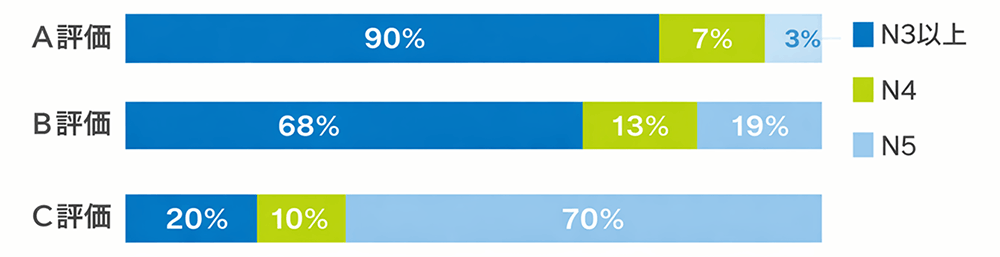
Assessment Criteria
| Level | Rnak / Score Range |
Level Content | |
|---|---|---|---|
| A (Equivalent to N3, B1) |
A+ | 91% - 100% |
Understands everyday
Japanese.
Japanese Study Hours: 450–750 Hours
|
| A- | 81% - 90% |
||
| B (Equivalent to N4, A2) |
B+ | 71% - 80% |
Understands basic
Japanese.
Japanese Study Hours: 300–500 Hours
|
| B- | 61% - 70% |
||
| C (Equivalent to N5, A1) |
C+ | 51% - 60% |
Understands basic Japanese to a
certain
degree.
Japanese Study Hours: 150–350 Hours
|
| C- | 41% - 50% |
||
| D (Equivalent to semi-N5) |
D+ | 31% - 40% |
Has a limited understanding of basic
Japanese.
Japanese Study Hours: 100–200 Hours
|
| D- | 21% - 30% |
||
| E | E+ | 11% - 20% |
Cannot understand basic Japanese and
frequently
lacks appropriate usage.
|
| E- | 0% - 10% |
||
- Study hour benchmarks are presented as ranges due to differences in learning times between learners from kanji and non-kanji language backgrounds.
Comparison with the Japanese-Language Proficiency Test (JLPT) Levels
The following relationship has been observed between the Practical Japanese Communication Exam (PJC Bridge) examinees’ assessment levels and their Japanese-Language Proficiency Test (JLPT) levels at the time of testing.
Learning Materials
Official Workbook
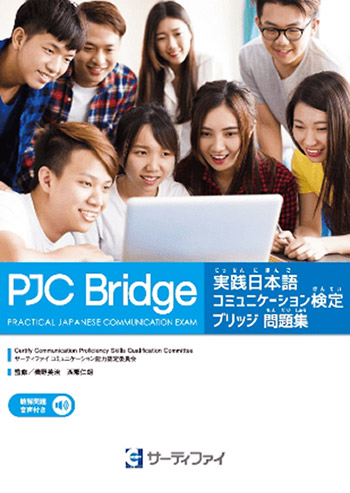
Official Workbook: Practical Japanese Communication Exam Bridge
- Price
- 1,430 yen + tax
- Supervised By
- Hideharu Isono / Jiro Nishigori
Includes an overview of the exam and three practice exams (with listening scripts, answer keys, and explanations).
- Printed copies of the workbook are not available outside Japan. Please purchase the digital version, which can be accessed on a Windows PC
How to Purchase the Official Workbook

Create a Shikaku Uketsuke ONLINE account

your My Page

Request your free PJC Bridge implementation materials and sample questions today.